Scottish Whisky and the Long Cash Game

A distiller who fills a cask today is making a decision about a market at least three years away, and often twelve, eighteen or more. In that time the duty on the bottle, the tariffs at the border, the barley harvest and the drinkers themselves will all change. Few industries ask so much of their balance sheet, or need such a long view to survive.
Scottish whisky is a clear example of something every manufacturer faces to some degree. Profit matters, but cash, time and judgement decide who is still standing when the cycle turns.
A cash cycle measured in years
By law, Scottish whisky must mature in oak casks in Scotland for at least three years. Single malts sold with an age statement are often ten, twelve or eighteen years old. Every one of those years, the distillery has already paid for the barley, the energy, the casks, the people and the warehouse space.
That makes maturing whisky a very large store of working capital. There are about 22 million casks maturing in Scottish warehouses, equal to roughly 12 billion bottles. The Financial Times has reported that five of the largest listed drinks groups now hold a record $22bn of ageing spirit between them.
Think about what a twelve-year-old whisky means for cash. A distillery that wants to sell twelve-year-old whisky every year has to carry twelve years of production at once. It pays for each year’s spirit up front and gets nothing back until that spirit is bottled and sold. If a retailer then takes 60 days to pay, the cycle stretches further still.
It also means forecasting demand more than a decade out. The amount of twelve-year-old whisky a brand can sell in 2038 is being decided in the stillhouse this year. Distil too much and the stock sits unsold, tying up cash and warehouse space. Distil too little and the brand runs short just when demand is there.
What one cask lives through
A cask filled in 2014 is twelve years old this year. In that time, the rules it will be sold under have changed again and again.
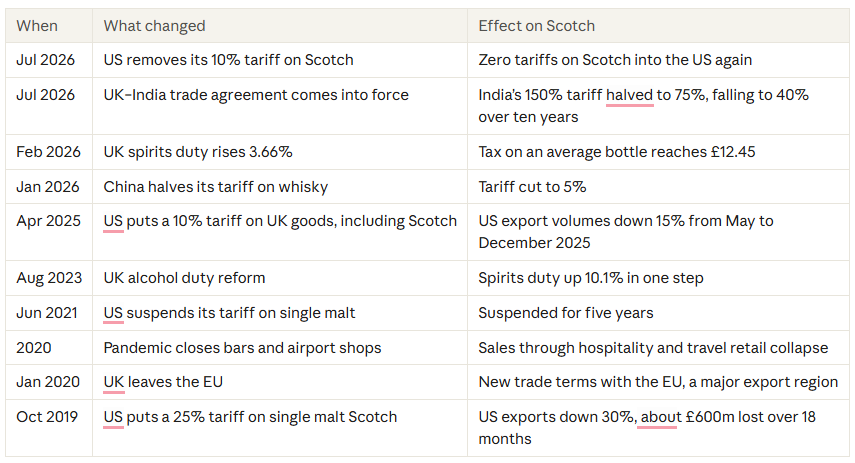
None of this could have been known when the cask was filled. The spirit inside it was costed, financed and laid down on assumptions that have since changed many times.
Duty at home
Spirits duty rose 3.66% on 1 February 2026. According to the Scotch Whisky Association, tax now takes £12.45 of the price of an average bottle of Scotch sold in the UK, or 71% of what the shopper pays. That is up from £10.58 in 2023, a rise of 18% in under three years.
The rises have not brought in more money. HM Treasury collected £4.06bn in spirits duty in 2025/26, £94m less than the year before, as people bought less. The industry is now asking for a cut in the Autumn Budget.
Duty is paid when whisky leaves the bonded warehouse for sale in the UK, not while it matures. So the stock in the warehouse does not carry duty. But every decision to lay that stock down was based on what it would sell for, and the duty rate at the point of sale is something a distiller cannot see from the stillhouse.
Tariffs abroad
Scottish whisky is sold in more than 160 markets, and tariffs can move faster than any distillery can respond. Exports were worth £5.36bn in 2025, 1.8% less than in 2024. Volumes fell 4.3%.
The United States is the largest market by value, worth £933m last year. A 10% US tariff from April 2025 cut US volumes by 15% between May and December. The industry spent months warning that the rate could rise to 35%. Then, on 24 July 2026, the US removed the tariff on Scotch altogether.
In the same month, the UK–India trade agreement came into force. India is already the largest market by volume, at 220 million bottles in 2025. Its import tariff on Scottish whisky halved from 150% to 75% on 15 July 2026, and is due to fall to 40% over ten years. China cut its tariff on whisky to 5% in January 2026.
So in just over a year, the largest market by value went from a 10% tariff, with the threat of 35%, back to zero. The largest market by volume halved its tariff. A distiller cannot plan around any single year’s rates. It has to plan for rates that will keep changing.
Barley, water and weather
About 90% of the barley used to make Scottish whisky is grown in Scotland, so the industry depends on Scottish weather. The 2025 harvest showed how quickly that can go wrong. Eastern Britain had a three-month spring drought, with the sunniest spring on record. Some spring barley struggled to emerge, and on lighter soils north of the Forth, screenings (grain too small to use) reached 30% in places.
At the same time, distillers needed less malting barley because demand for whisky had fallen. Maltsters warned growers to plant less, much of the UK crop failed malting specification and went to animal feed, and prices dropped. Many growers now expect to plant less malting barley in 2026.
That creates a risk for later. Farmers who switch crops do not always switch back, and the barley a distillery needs when demand recovers has to be planted the year before. Water matters too. In dry summers, some distilleries have had to stop production while the burns they draw from ran low. A long-term view of supply means long-term relationships with growers, and planning for the weather as well as the market.
When demand turns
After fifteen years of growth, demand for Scottish whisky has fallen. People who stocked up during the pandemic have plenty at home, many are drinking less, and prices have risen. The result is a growing “whisky loch” of unsold stock, a phrase from the glut of the early 1980s.
Producers are responding. Cutting production protects cash now. It also creates gaps in the age profile of future stock. The last whisky loch, in the early 1980s, led to the closure of distilleries including Port Ellen and Brora in 1983. Their remaining casks later became highly prized, and Diageo has since reopened both. The spirit not made in a downturn is the spirit that is missing when demand returns.
Costs that keep moving
Duty and tariffs get the headlines, but almost every other cost of running a distillery has changed too. Each change lands on spirit that was costed years before it will be sold.
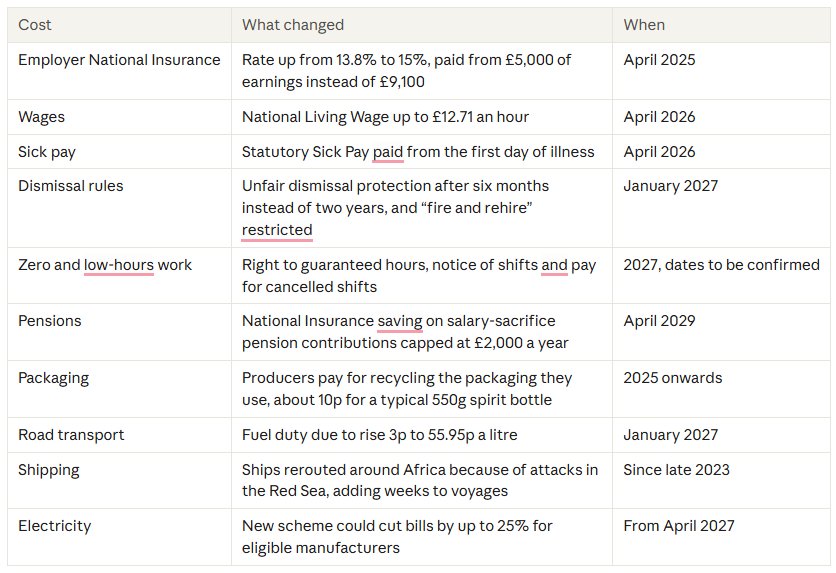
The people costs add up quickly. A full-time employee on the National Living Wage now costs an employer about £28,300 a year, including National Insurance and pension. That is about £2,900 more than two years ago. The 2027 changes on hours and dismissal will also affect how distilleries staff the seasonal peaks in bottling, warehousing and visitor centres.
Energy has swung sharply since 2022, and distilling needs a lot of heat and power. The new British Industrial Competitiveness Scheme may help, but it covers electricity only and has strict sector tests, so each distiller needs to check whether it qualifies.
None of these costs can be passed back to whisky already in the cask. They come out of the margin on stock that was priced on yesterday’s assumptions. That is why long-cycle businesses need budgets rebuilt from the bottom up each year, and standard costs that are kept up to date.
Why diversification matters
When any one cost, market or tax can change this fast, a business that depends on one of each is exposed. Diversification is how distillers spread that risk, and it comes in several forms.
Markets. Scottish whisky is sold in more than 160 markets. In 2025 and 2026, the US fell back while India grew and China cut its tariff. A distiller selling into many markets can ride out a shock in one of them.
Products. The same stock can become blends or single malts, younger whiskies or older ones, or casks finished in other woods. Many newer distilleries also make gin or vodka while their whisky matures.
Channels. Shops, bars, airports, online sales and direct sales all behave differently in a downturn. Selling casks to blenders and independent bottlers is another outlet for surplus stock.
Visitors. Scotland’s distilleries had 2.7 million visits in 2024. Tours, tastings and shops bring in cash this year from whisky that will not be sold for a decade.
Suppliers. More than one source of malt, casks and glass, on longer contracts, reduces the risk of any one failing or putting its prices up.
The timing of cash is the key point. A visitor centre or a gin brings money in within weeks. That helps fund stock that will not earn anything for years, and reduces how much the business needs to borrow at the peak.
Diversification has costs of its own. Every new product needs its own recipe, costing, forecast, stock and packaging, and every new market its own labels, rules and partners. Done without that discipline, it adds complexity faster than it adds profit. The aim is a spread of income that holds up when one part of the business is under pressure, at a level of complexity the team can manage.
Why long-term vision is a financial discipline
Long-term vision in whisky comes down to a set of financial habits. The distillers who come through each cycle tend to share them.
They plan in scenarios. They test a range of demand, duty and tariff cases, and know what each one does to profit and cash.
They know their peak funding need. Maturing stock needs long-term money: equity, long-term loans or facilities secured on the stock. Funding it with a short-term overdraft that can be withdrawn is how good businesses fail.
They know what it costs to hold stock. Interest, warehousing, insurance and the angel’s share, the spirit lost to evaporation, all add to the cost of every year a cask waits.
They keep their options open. They spread their risk across markets, products, channels and suppliers, and keep stock flexible enough to move between them.
They keep relationships through the cycle. Growers, coopers, warehouse staff and customers are all harder to win back than to keep.
They keep laying down some spirit in a downturn. Barley and capacity cost less when demand is low, and the gap left by stopping completely shows up years later.
What every manufacturer can take from whisky
Most manufacturers do not wait twelve years to sell what they make. But the same forces are at work, on a shorter clock.
Profit is not cash. A business can report a profit and still run out of money to pay its suppliers and staff. Working capital, and the peak in it, decides that.
Judge results over the full cycle. When a distillery pauses production, its fixed costs stay, and monthly accounts show the overhead it has not covered. A seasonal or long-cycle business has to judge its performance across the cycle, not month by month.
Standards and variances need care. Costs set years ago and reported against today’s prices produce variances that measure the out-of-date standard more than the factory.
Supply chains need looking after. The grower who switches crop this year may not be there when demand returns.
Spread the risk, and count the cost. More markets, products and channels make a business more resilient, but each one adds complexity that has to be costed and managed.
Plan for change you cannot predict. Duty, tariffs and the weather will move. Build plans that still hold up when they do.
Manufacturing Finance for Operations Leaders
These are the questions at the heart of Manufacturing Finance for Operations Leaders, a two-day executive education programme from The Ogilvie Business School in Dundee.
Led by Heather Ogilvie, a former Group CFO, Chartered Accountant and international turnaround specialist, the programme shows how decisions on the factory floor become profit and cash. It covers product costing, overhead absorption, inventory and working capital, forecasting, KPIs and financial reporting. No finance qualification is needed.
Dates: 25 to 26 November 2026, or 10 to 11 March 2027
Location: Dundee, Scotland
Investment: £1,275 plus VAT, including a CPD certificate
Not ready to book yet? Our 40-page booklet works through one seasonal drinks manufacturer from fruit contract to cash, and a free guide to manufacturing finance terms is available on the programme page.
Sources
Scotch Whisky Association, 2025 export figures (February 2026)
Scotch Whisky Association, Facts & Figures
Scotch Whisky Association, International trade
Scotch Whisky Association, Scotch Whisky tax rises by 3.66%
Vinetur, Scotch Whisky group urges Britain to cut spirits duty (14 October 2026)
The Spirits Business, US lifts tariffs on Scotch (24 July 2026)
The Drinks Business, India tariff cut opens door to wider Scotch whisky market (23 July 2026)
Simpsons Malt, 2025 barley harvest: drought, quality and 2026 market outlook (November 2025)
The Spirits Business, Diageo halts production at Roseisle maltings (November 2025)
Brit Brief, Scotch distilleries pause production as whisky loch grows (September 2026), citing the Financial Times
Manufacturing.net, Suspension of costly US tariffs welcomed by Scotch whisky makers (June 2021)
VinciWorks, Employment Rights Act 2025 implementation timeline (updated July 2026)
Protax, The true cost of employing someone in the UK in 2026
Pensions Age, Pensions salary sacrifice cap passes into law (April 2026)
Pattesons Glass, What EPR, PRN and PPT actually cost your glass packaging in 2026 (May 2026)
Transport News, Planned fuel duty rises will drive up costs for hauliers (September 2026)
Gulf News, Container shipping heads toward a harder 2026 as Red Sea reopening pressures rates (February 2026)
CMS, British Industrial Competitiveness Scheme update (April 2026)